


Time flies when you’re having fun and that certainly goes for developing this main release, so in a way, I am sort of apologizing for the longer wait than we initially promised you.
The ISO development team and the community editions team have been working very hard to improve the EndeavourOS installation experience for a newly installed system. Perhaps needless to say but once installed, EndeavourOS keeps rolling, so existing users don’t have to install Apollo.
New features

This release has some new features on the ISO and after installation, we are very excited to share them with you.
New features and fixes on the ISO:
- We changed the internet check not to rely on GitHub or GitLab and preventing a failed internet connection error in countries where either GitHub or GitLab is blocked by using:
internetCheckUrl: https://geoip.kde.org/v1/calamares - A fix when Xfce4 and i3 are both selected for installation – This fix solves the issue of double installed packages causing conflicts during install of the DE in combination with our i3 flavour.
- Community editions now install with their dedicated Display Manager – Instead of using LightDM + Slickgreeter as the default, the community editions now are installed with the best DM option for the chosen Window Manager. The DMs used are: LightDM + Slick greeter, Lxdm, ly and GDM.
- Different order DE option and Package chooser – Calamares now lets the user choose the Desktop Environment first, before going to the package selection page to install other packages like another kernel etc. This was done to provide a better description of each option and prevent the user from installing the system without a DE using the online installer.
- Fix to Firefox getting installed when not chosen – Thanks to the community we were able to solve this issue.
- Qogir icons and cursor is used on Live environment and offline XFCE4 install – Previously we’ve used the Arc icon theme. The Qogir icon and cursor theme is also available in our repo.
- New info button for customised installation – The button leads to a manual to add some scripts for a customised installation.
- Rewritten custom EOS modules for better Calamares integration – Pacstrap and cleaner scripts have been rewritten for a smoother experience.
- When using a custom user_pkglist file, those packages are now displayed on the netinstall page so you can confirm what will be installed
- Toggle log button inside Calamares – This option has replaced the terminal window that used to open simultaneously behind the Calamares window, to read the progress during install. Now, when clicking on the toggle log button, the info appears within the Calamares window that, when disabled, normally shows the slides.
- During the online install processes, there is now status shown below the progress bar to make it clear what is happening.
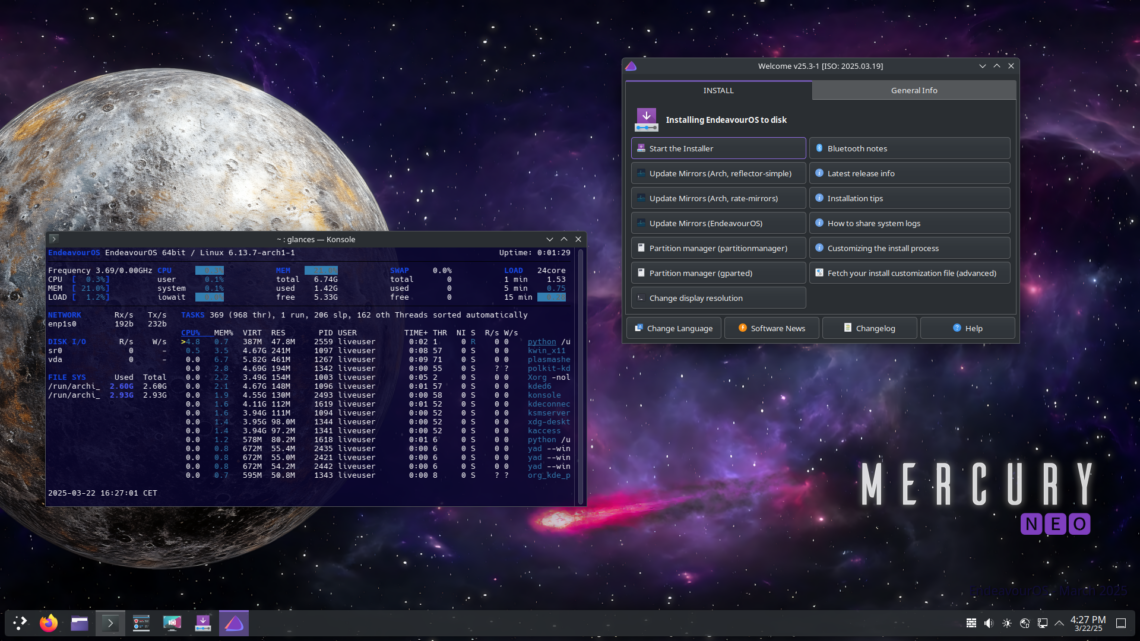
- Bluetooth is enabled in the Live environment – Now you can check if Bluetooth is working on your hardware if you want to run EndeavourOS, however after install Bluetooth is disabled by default. We have created a new Bluetooth button that directly links you to our wiki on the installed system.
- Compression is now being applied to the installed files for btrfs installs – In prior releases, compression was only applied to files post-install
New features and fixes on the installed system:
- FirewallD is enabled – Each Apollo installation has FirewallD already installed and enabled after install.
- EOS-quickstart – A new GUI app created by Dalto, who joined our core development team in January, that helps you choose and install the most common and helpful apps on a new installed system. NOTE: The selection of apps is coming from the Arch repo and not from the AUR.
- EOS-packagelist – This app replaces EndeavourOS-packages-lists and is an easy way to get access to the lists of packages used by each part of the installer at any time
- Nvidia-inst – A brandnew app that is a rewritten version of our existing nvidia-installer-dkms app. It is a command line tool that helps you install the mainstream Nvidia driver, legacy drivers 470 and 390 drivers. (Thanks to Jonathon) and several Hybrid set-ups such as Bumblebee and Prime. NOTE: This tool is still in beta, so feedback is appreciated. Our nvidia-installer-dkms is still installed and operational for that reason, although that app doesn’t install hybrid and legacy drivers.
- Autoranking hook for the EndeavourOS-mirrorlist – It detects and implement mirror ranking to the closest one when changes occur for the EndeavourOS mirrorlist, NOT the Arch mirrors.
- An addition to eos-rankmirrors – Received the addition of options –prefer and –ignore to prefer and ignore certain mirrors in the EndeavourOS-mirrorlist.
- Fix for the Reboot info message after update for Refind users – A fix has been made to show the reboot message after a core update using Refind.
- Fixed generated Grub code – Previously it was set to work with bash-only, now it also works with dash.
Worm, a brand-new Window Manager

This release is also shipping with a brand-new Window Manager developed by our community editions team member Codic12 and we are more than proud to present you this WM that was developed a little bit under our wing.
Codic12 decided to develop this WM to satisfy his need for a lightweight window manager that worked well with both floating and tiling modes and had window decorations with minimise, maximise and close buttons in any layout desired and that could run on a semi-embedded system like the PIZero.
Worm is written in Nim and is based on X11, a Wayland version isn’t in the pipeline in the near future, according to him.
It does implement most of the important bits of the EWMH and ICCCM specifications, so most applications should run just fine, and if they don’t, please feel free to report a bug, so he can try to fix it.
We’ll hope you will enjoy the Apollo release, to download the ISO just visit our download page.


Hello. First-of-all I’d like to say “Thankyou for making such an AWESOME-and-AMAZING distro 🙂 “.
Anyway, to go straight to the point,
I was-wondering if there was any way to
●disable FirewallD (ie. shut it down / turn-it-off completely)
and/or
● that it DOESN’T get-installed when you’re installing a “fresh”[/clean] installation of EndeavourOS Linux. ([regardless of] whether it be an “online”-installation or an “offline”-installation).
I ask this because (as far as I know anyway) “FirewallD” is the Firewall-version used in RedHat, and I’m MUCH more comfortable using G.U.F.W. (“Graphical Uncomplicated Firewall”). I’ve used it on ALL the Linux distros I’ve used (Zorin OS, Linux-Mint, Manjaro Linux, & now moving to EndeavourOS)
(a White-Hat B.F.F. of mine suggested I try “Arch-based” Linux distros, saying I’d be more-comfortable with them and-have more-control over what goes on inside my computer and what-programs get installed with it).
I commend you for installing (and/or preinstalling) a -related program for one’s-Linux-operating-system to be kept safe; but I-was-wondering if there was a way to NOT have FirewallD installed, when doing a clean–and/or–fresh installation of EneeavourOS.
I’ve done research on both FirewallD and G.U.F.W. and searched “FirewallD review”__and__”FirewallD vs GUFW” as well, and I’m *still* reading all the articles that-I’ve-found–thus-far, but so-far my research has shown me that for a total Linux newbie on a bunch of things like I currently am (I’m currently more of a “Intermediate”-level Linux user) (I’ve also taken The-Linux-Foundation’s “Introduction to Linux”-course, by the way), “G.U.F.W.” would be easier on me for the time being. (Just set it to “Profile: Home. Status: On. Incoming: Deny. Outgoing: Allow” [and that’s it]).
The Comments-section erased a portion of my message:
I had written “I commend you for installing (and/or preinstalling) a Security-related and Safety-related software program” (and the rest of what I wrote).
Hi Elaine, my apologies for the late reply. You can deselect the firewall in the installer, when you click on the base system in the package selector, you simply can unselect the box.
@Bryanpwo’s comments
—
Hi Elaine, my apologies for the late reply. You can deselect the firewall in the installer, when you click on the base system in the package selector, you simply can unselect the box.
–:
@”my apologies for the late reply”:
I understand 🙂 . Apology accepted 🙂 . Thankyou SO MUCH for replying 🙂 . Also: Thankyou SO MUCH for the information 🙂 . It was a really big help 🙂 .
@joekamprad’s comments
—
It is in addition easily possible to disable and replace FirewallD on installed system, also we decide to take FirewallD by a reason instead of GUFW. Where GUWD looks simpler on the first view it is not easy to handle on the long run. Anyway firewalld can be disabled like so `sudo systemctl disable firewalld` after reboot it will not be active anymore and you can go to uninstall it and replacing with another one.
–:
Thankyou SO MUCH for the information 🙂 . It, like @Bryanpwo’s comments, was a really huge help also 🙂 . Also: You’ve given me alot to think-about:
In the article https://www.ctrl.blog/entry/ufw-vs-firewalld.html , for example, it says “Fedora and Red Hat Enterprise Linux enables FirewallD by default. Its firewall-cmd front-end has almost the same feature set for basic firewall management as ufw, and adds network zone management to the mix.”
And the webpage https://www.reddit.com/r/archlinux/comments/3aroy1/firewalld_vs_ufw/
has the post “FirewallD is probably going to become the standard IPC interface to iptables.”
(Plus the other stuff it says (I don’t want to post it all because I don’t want this post to get flagged by the Automated Spam-filter)).
These comments & the-part–in-your-post
“also we decide to take FirewallD by a reason instead of GUFW. Where GUWD looks simpler on the first view it is not easy to handle on the long run.”
has caused me to think that maybe and/or perhaps it’s a better-idea that I keep FirewallD for now.
(I’m of the habit “don’t touch what I don’t know-about”, which I learned by force, when I accidentally messed-up my Windows95 computer just by cut-and-pasting the files from the C drive to the Desktop, which I thought would be okay because the Desktop IS technically still partnof the C drive).
I also ran-into the interview
https://www.youtube.com/watch?v=5DVxy7tY56A
and the webpage-article
https://forum.endeavouros.com/t/why-is-this-distro-called-endeavour/17385 ,
and I once-again commend everyone for making such an AMAZING-and-AWESOME Linux distro ☺. Plus the fact that it was made by, like me, a newbie to Linux (like I am) and a bunch of people that are PASSIONATE about Linux and/or Computers, makes me feel like if I am part of a family and/or community — a Linux community — and can provide my-feedback-and/or-help whenever I can. I don’t know much computer-code (yet
(a computer-teacher taught us how to make a website using HTML and Notepad when I was in 10th-grade but I’ve since forgotten how to do HTML code. It’s in the back of my brain somewhere, LOL) ),
but I’m willing to learn ☺, and I’ll sure-help whenever-and/or-however I can. (Proofreading texts, learning about the distro and helping-out any other newbies that need it, etcetera. I am willing to help-out any way that I can ☺).
Once again, Thankyou for making such an AWESOME distro, and for the quick and prompt replies and all tne useful information ☺.
Darn.
On my previous post, the blushes were actually supposed-to-be 🙂 . (I’m writing this on a old Samsung Galaxy Tab A (2016), and the emoticon on the on-screen keyboard looked like a 🙂 and it didn’t show-up as a blush until AFTER i posted my message. Please disregard all the blushes and change them to smiley-faces. Thankyou 🙂 ).
It is in addition easily possible to disable and replace FirewallD on installed system, also we decide to take FirewallD by a reason instead of GUFW. Where GUWD looks simpler on the first view it is not easy to handle on the long run. Anyway firewalld can be disabled like so `sudo systemctl disable firewalld` after reboot it will not be active anymore and you can go to uninstall it and replacing with another one.
I can easily go along with Elaine’s objection. To me it seems, Firewalld is pre-configured for people using EOS on a server, not as an end user. Why else would ipv6 and ssh be allowed as incoming requests in general?
Please, correct me, if I’m wrong.
Additionally, I’d like to suggest apparmor and unbound as services installed.
Unbound, like so:
https://www.privacy-handbuch.de/handbuch_93c.htm
I am aware, that this unbound-config might be just too much for many, but since EOS is so great, and I love it very much, I still post it here.
*Cheers*
My unbound.conf file, according to suggestion is not setting up any local server, but just serves personal privacy while surfing the web (see https://www.privacy-handbuch.de/handbuch_93c.htm):
————————————————————————-
server:
tls-cert-bundle: /etc/ssl/certs/ca-certificates.crt
trust-anchor-file: trusted-key.key
# verbosity number, 0 is least verbose. 1 is default.
verbosity: 1
hide-identity: yes
hide-version: yes
root-hints: root.hints
### Forwarding using DNS over TLS:
forward-zone:
name: “.”
forward-tls-upstream: yes
### Begin “Tls-Upstream No-Filter-Sektion”
# Freifunk München
forward-addr: 195.30.94.28@853#dot.ffmuc.net
forward-addr: 185.150.99.255@853#dot.ffmuc.net
# Digitalcourage e.V.
forward-addr: 5.9.164.112@853#dns3.digitalcourage.de
# Digitale Gesellschaft (CH) DNS Server
forward-addr: 185.95.218.42@853#dns.digitale-gesellschaft.ch
forward-addr: 185.95.218.43@853#dns.digitale-gesellschaft.ch
# Censurfridns Denmark (aka. UncensoredDNS)
forward-addr: 91.239.100.100@853#anycast.censurfridns.dk
forward-addr: 89.233.43.71@853#unicast.censurfridns.dk
# AdGuard DNS-Server OHNE Werbe- und Trackingfilter
forward-addr: 94.140.14.140@853#dns-unfiltered.adguard.com
forward-addr: 94.140.14.141@853#dns-unfiltered.adguard.com
# Mullvad DoT und DoH-Server OHNE Werbe- und Trackingfilter
forward-addr: 194.242.2.2@853#doh.mullvad.net
forward-addr: 193.19.108.2@853#doh.mullvad.net
### Begin “Tls-Upstream Werbeblocker-Sektion”
# Dismail.de DNS Server
forward-addr: 80.241.218.68@853#fdns1.dismail.de
forward-addr: 159.69.114.157@853#fdns2.dismail.de
# dnsforge.de DNS Server
forward-addr: 176.9.93.198@853#dnsforge.de
forward-addr: 176.9.1.117@853#dnsforge.de
# BlahDNS DE Server
forward-addr: 78.46.244.143@853#dot-de.blahdns.com
forward-addr: 45.91.92.121@853#dot-ch.blahdns.com
forward-addr: 95.216.212.177@853#dot-fi.blahdns.com
# AdGuard DNS-Server MIT Werbe- und Trackingfilter
forward-addr: 94.140.14.14@853#dns.adguard.com
forward-addr: 94.140.15.15@853#dns.adguard.com
# Mullvad DoT und DoH-Server MIT Werbe- und Trackingfilter
forward-addr: 194.242.2.3@853#adblock.doh.mullvad.net
forward-addr: 193.19.108.3@853#adblock.doh.mullvad.net
Make the printer install work. Every other distribution, Mint, Fedora, Manjaro etc. finds and installs the network printer without problem.
Hello again 🙂 .
First off / First of all, I would like to apologize (or “apologise” in UK-English-spelling) if this is a dumb question 🙁 . Anyway, I was wondering if I could use one of these as the wallpaper for my EndeavourOS-Linux Desktop background https://endeavouros.com/media-images/ . The one at https://endeavouros.com/wp-content/uploads/2021/03/EndeavourOS_2.jpg is the one I’d like to use 🙂 .
Also, I’d like to correct a typing-error I made at the post “which I thought would be okay because the Desktop IS technically still partnof the C drive).”
It should have been “part of”, instead of “partnof” 😛 .
Anyways,
Once-again Thankyou for making such an AWESOME Linux distro 🙂 .
No problem, you can download it on the page, or you could click on the button “add more EndeavourOS wallpapers” in the Welcome app, you then can find them in the community wallpapers section.
Thankyou so much! 🙂 , and, Thankyou-so-much for the information! 🙂